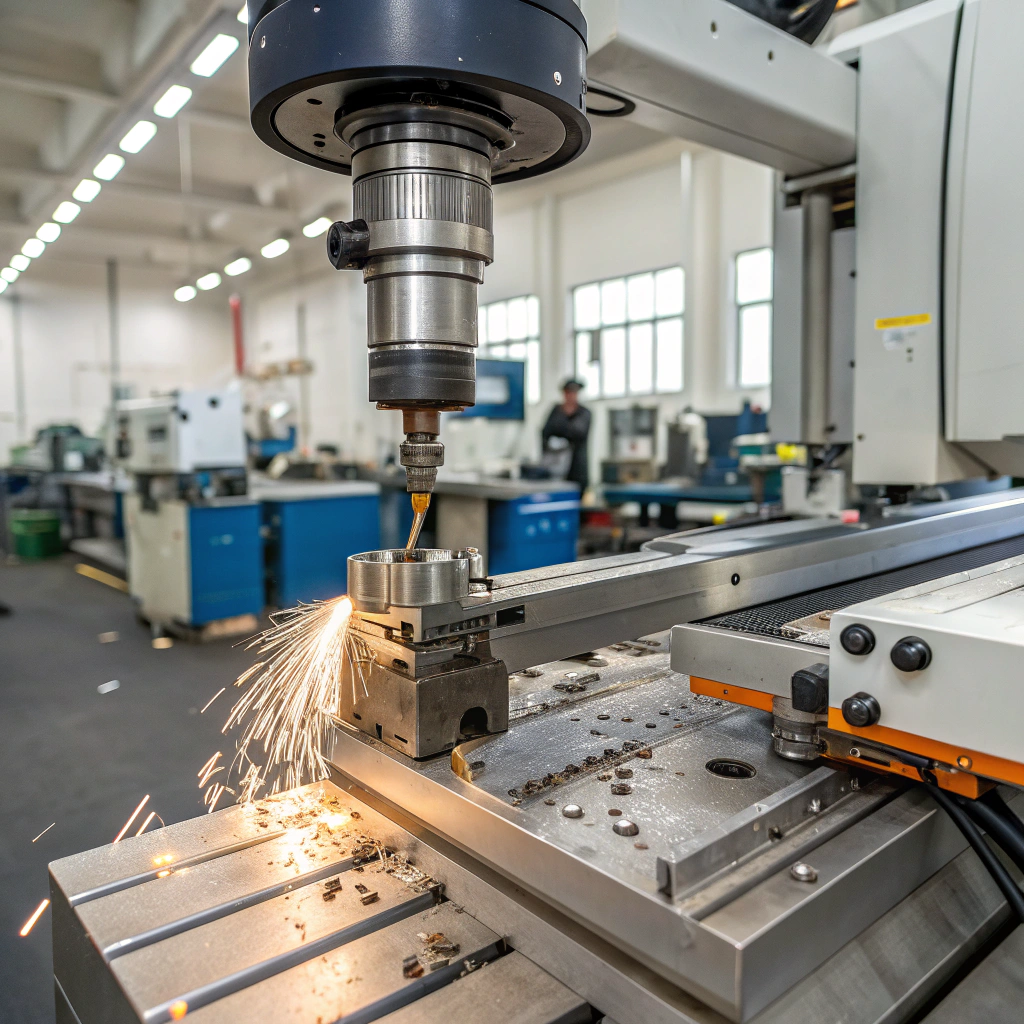
When tool life and cut quality start slipping, the culprit is often the wrong speed. I had that happen once—with a cutter that overheated after only ten minutes of run time.
SFM (Surface Feet per Minute) is the measure of how fast the cutting edge of a tool moves across the surface of a workpiece in machining.
That simple number controls tool wear, finish quality, and productivity.
Now let’s dig in step by step so you can apply SFM confidently in your process.
Why is SFM calculation crucial?
When things go wrong—tool breaks, finish looks rough, cycle time drags—it often traces back to speed.
Getting the correct SFM means you pick a spindle speed and tool diameter so that the cutting edge travels at the optimal speed for the material and tool.

Why exactly it matters:
- Tool life: If SFM is too high, the cutter overheats and dulls quickly. If too low, the tool rubs instead of cutting, again shortening life.
- Surface finish and accuracy: Proper cutting speed helps get a clean cut, minimal burrs, and predictable dimensional accuracy.
- Productivity: Using the right SFM increases material removal rate and reduces cycle time while preserving tool life.
- Cost efficiency: Fewer tool changes, less downtime, less scrap.
- Consistency: When you know how to calculate SFM you standardize setups and get repeatable results.
| What happens when SFM is too low | What happens when SFM is too high |
|---|---|
| Tool rubs, poor finish, slow removal | Tool overheats, wears fast, may chip |
| Longer cycle time | Risk of tool failure or part damage |
| Potential poor dimensional control | Higher cost per part |
How to calculate SFM step by step?
Now I’ll walk you through how I do it every time I set up a job. I keep it simple so a new machinist or a seasoned one can follow.
To calculate SFM, use the formula SFM = (RPM × π × Diameter) / 12. You can reverse the formula to find RPM if you already know the SFM.
Step‑by‑step guide:
- Identify tool or workpiece diameter (D)
- Decide on your target SFM
- Use the SFM formula
[
\text{SFM} = \frac{\text{RPM} \times \pi \times D}{12}
] - Solve for the missing value
[
\text{RPM} = \frac{\text{SFM} \times 12}{\pi \times D}
] - Convert units if needed
- Check against material/tool limits
- Record and use for future jobs
Example calculation:
- Cutter diameter D = 1.5 inches
- Desired SFM = 300 ft/min
[
\text{RPM} = \frac{300 \times 12}{\pi \times 1.5} \approx \frac{3600}{4.712} \approx 764 RPM
]
| Cutter Diameter (inches) | Desired SFM (ft/min) | Approx. RPM |
|---|---|---|
| 1.0 | 250 | 954 |
| 2.0 | 300 | 572 |
| 0.75 | 200 | 1019 |
Key notes:
- Always verify with tool and material charts
- Feed rate must also be matched
- Use coolant when needed to manage heat
What are the trends in machining speed optimization?
The machining world is changing fast. The rules for SFM and speeds are being pushed by new machines, coatings, automation and data analytics.
The latest trends in machining speed include high-speed machining, smart adaptive controls, new coatings, and digital simulations to optimize SFM in real-time.

1. High-Speed Machining (HSM)
Machines now support 30,000–50,000 RPM. Combined with small tools, this raises achievable SFM drastically.
2. Coated and advanced tooling
TiAlN, AlCrN, and PCD coatings resist heat better, allowing higher SFM and feed rates.
3. Real-time analytics and adaptive systems
Smart CNCs now adjust RPM/feed on the fly to keep SFM optimized based on actual tool load.
4. CAM software and simulation
Digital twins simulate machining ahead of time—letting us tune SFM before we ever cut metal.
5. Multi-axis machining
5-axis tools change how the cutter contacts material, affecting actual SFM constantly. Systems now adjust for this automatically.
6. Energy efficiency and optimization
The goal now isn’t always faster—it's better. Shops are tuning SFM for the best balance of speed, energy, and tool life.
Conclusion
Calculating and managing the correct SFM is one of the fundamentals of good machining. It underpins tool life, surface finish, and productivity. As machines, tooling and data tools evolve, the way we apply SFM is also evolving—what used to be rule-of-thumb is being replaced with real-time adaptation and digital optimization. Keep refining your SFM calculations, check results, and you’ll see better outcomes on your shop floor.